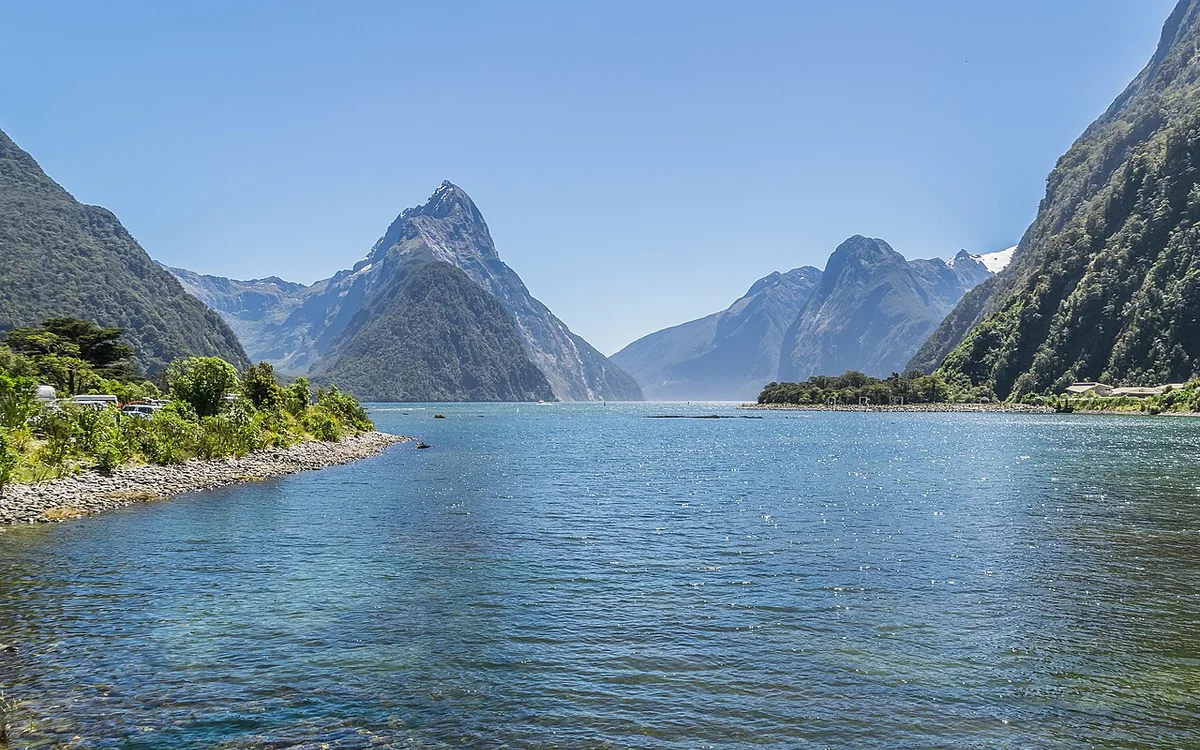
Milford Sound / Piopiotahi
The eighth wonder of the world: sheer granite cliffs plunging thousands of feet into primordial waters.
Geographic Essence & What Makes It Unique
Described by Rudyard Kipling as the "eighth wonder of the world," Piopiotahi / Milford Sound is the crown jewel of Fiordland National Park. Carved by gargantuan ice age glaciers, its sheer granite walls ascend nearly straight out of the dark, tannin-stained sea waters up to 1,200 meters into passing clouds. During Fiordland's legendary downpours—receiving up to seven meters of rain annually—hundreds of temporary waterfalls sprout instantly along the cliff faces, blown upward by oceanic gusts.
Concrete Landmarks & Terrains to Explore
Mitre Peak (Rahotu)
The iconic pyramid-shaped mountain summit rising 1,692 meters directly from the water's edge.
Stirling Falls
A perennial 151-meter waterfall that cascades between the sheer Elephant and Lion rock formations.
Homer Tunnel & Cleddau Valley
Hand-carved 1.2-kilometer alpine tunnel piercing through sheer solid granite cliffs of the Darran Mountains.
Milford Sound Underwater Observatory
Submerged viewing chamber at Harrison Cove showcasing rare deep-water black coral trees living in shallow waters.
Core Exploration Experiences
- Cruise through the fiord by boat or kayak up to the churning spray of Stirling Falls and Lady Bowen Falls.
- Hike the world-renowned 53-kilometer Milford Track, traversing mountain passes and beech rainforests.
- Drive the Milford Road (State Highway 94) through the historic Homer Tunnel and Eglinton Valley.
- Spot native wildlife including New Zealand fur seals basking on rocks, Fiordland crested penguins, and bottlenose dolphins.
Seasonality & Optimal Travel Months
November through April provides longer summer days and warmer temperatures. However, Milford Sound is spectacular even in heavy rain, when thousands of waterfalls spring to life.
Balanced Editorial Assessment
Key Advantages
- Some of the most sheer and dramatic coastal fjord geology anywhere on Earth.
- Breathtaking scenic approach via the Milford Road, an attraction in its own right.
- Thriving wildlife encounters with native fur seals, dolphins, and playful kea alpine parrots.
Drawbacks & Real Challenges
- One of the wettest inhabited places on Earth, averaging around 180 rainy days per year.
- Voracious sandflies (blackflies) thrive near the water's edge and require strong insect repellent.
- Winter weather and heavy snow can temporarily close the Homer Tunnel alpine road.
Field Notes & Planning Intelligence
- Base your stay in Te Anau rather than Queenstown to cut the driving time in half and reach the fiord before tour buses.
- Bring heavy-duty rain gear and embrace wet weather—rain transforms the fiord into a cascade wonderland.
- Apply strong insect repellent containing DEET to ward off persistent sandflies.
Comparable Geographic Alternatives
Verified Research Sources
This profile was verified using records from primary government, conservation, and meteorological bodies.
- Department of Conservation New Zealand (DOC) — Milford Track Great Walk hut bookings, avalanche risk management, and Fiordland marine reserves.
- UNESCO World Heritage Centre — Outstanding universal value for glacial gouging, primeval podocarp rain forest, and endemic fauna.
- MetService New Zealand — Fiordland annual precipitation records averaging between 6,000 and 8,000 mm of rain annually.