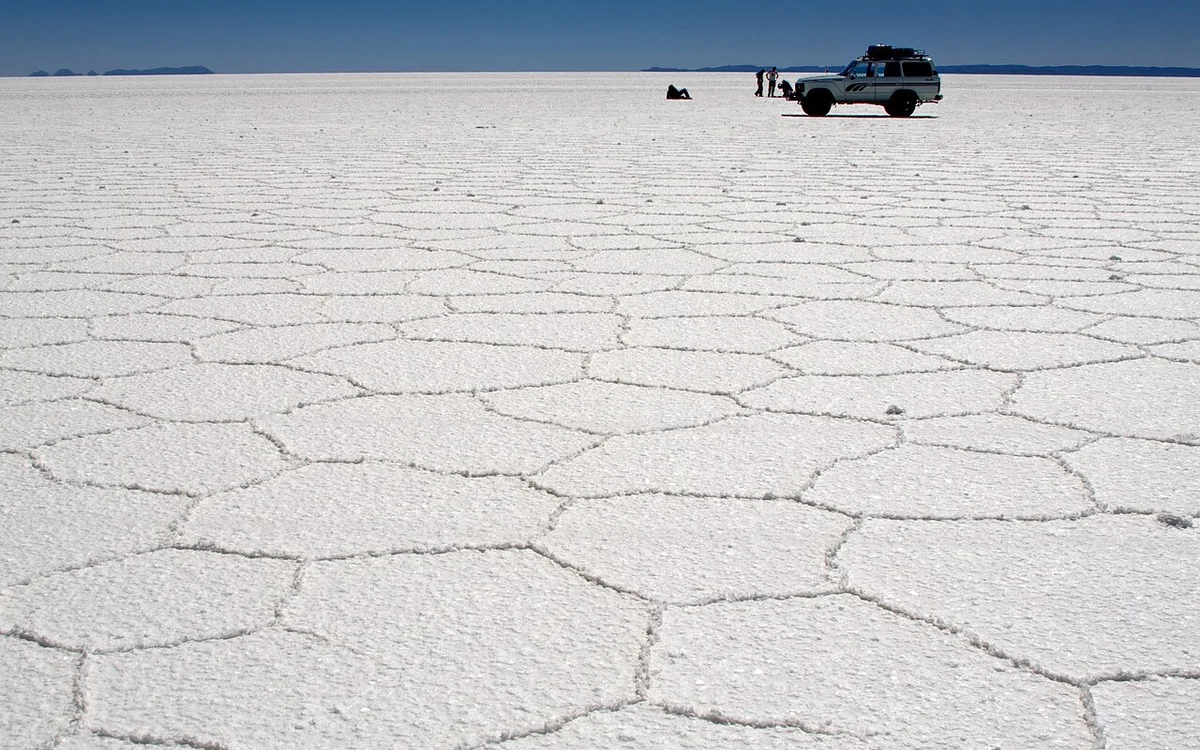
Salar de Uyuni
The world's largest salt flat: infinite hexagonal salt crusts and seasonal giant sky mirrors.
Geographic Essence & What Makes It Unique
Spanning more than 10,500 square kilometers across the high windswept Bolivian Altiplano at 3,656 meters above sea level, Salar de Uyuni is the largest salt flat on Earth. Formed by prehistoric lakes that evaporated thousands of years ago, the salt crust stretches flat to the horizon with less than one meter of altitude variation across the entire expanse. In the dry season, it presents a blinding white sea of polygonal salt tiles; during the rainy season, a thin film of water transforms it into the world's largest mirror.
Concrete Landmarks & Terrains to Explore
Incahuasi Island
Hilly outcrop of ancient coral limestone covered in hundreds of giant cacti up to 10 meters tall in the center of the salt flat.
Laguna Colorada
Shallow salt lake dyed rust-red by pigmented algae, dotted with thousands of feeding James's and Andean flamingos.
Sol de Mañana Geysers
High-altitude volcanic geothermal field at 4,850 meters venting boiling mud pools and sulfuric steam into freezing morning air.
Train Cemetery (Cementerio de Trenes)
Ghostly collection of abandoned 19th-century steam locomotives corroding in the salt winds outside Uyuni town.
Core Exploration Experiences
- Watch sunrise and sunset reflect perfectly across the flooded salt flat mirror during the rainy season.
- Climb through the giant trichocereus cacti on Incahuasi Island rising from the middle of the white salt sea.
- Take surreal forced-perspective optical illusion photos across the flat, featureless salt horizon.
- Continue on a 3-day 4x4 expedition into the Eduardo Avaroa Reserve past red lagoons teeming with Andean flamingos.
Seasonality & Optimal Travel Months
May to October offers crisp, dry weather with bright white hexagonal salt patterns and easy 4x4 navigation. January to March brings rainfall that creates the famous giant reflective sky mirror.
Balanced Editorial Assessment
Key Advantages
- A completely unique, otherworldly landscape with no true equivalent on Earth.
- Dual personalities: crisp hexagonal white crust in winter, surreal mirror reflections in summer.
- Very high value per dollar for multi-day guided expedition packages.
Drawbacks & Real Challenges
- Extreme altitude (3,650m to nearly 5,000m) carries real risks of acute altitude sickness (soroche).
- Sub-zero nighttime temperatures in basic refuge shelters with minimal heating.
- Flooded salt during wet months can restrict vehicle access to Incahuasi Island for safety.
Field Notes & Planning Intelligence
- Acclimatize in La Paz, Sucre, or Potosí for at least 2–3 days before beginning an Uyuni expedition.
- Bring thermal base layers, heavy gloves, wool hats, and high-SPF UV sunglasses for intense glare.
- Verify that your tour operator has an emergency oxygen tank and seatbelts for all passengers in the 4x4.
Comparable Geographic Alternatives
Verified Research Sources
This profile was verified using records from primary government, conservation, and meteorological bodies.
- Viceministerio de Turismo de Bolivia — Certified 4x4 expedition operator licensing, altiplano safety rules, and Eduardo Avaroa reserve entry.
- Servicio Nacional de Áreas Protegidas (SERNAP) — Laguna Colorada and Laguna Verde wetland conservation zones and flamingo protections.
- Servicio Nacional de Meteorología e Hidrología (SENAMHI) — High-altitude altiplano solar radiation readings and sub-zero night freeze records.