Sossusvlei
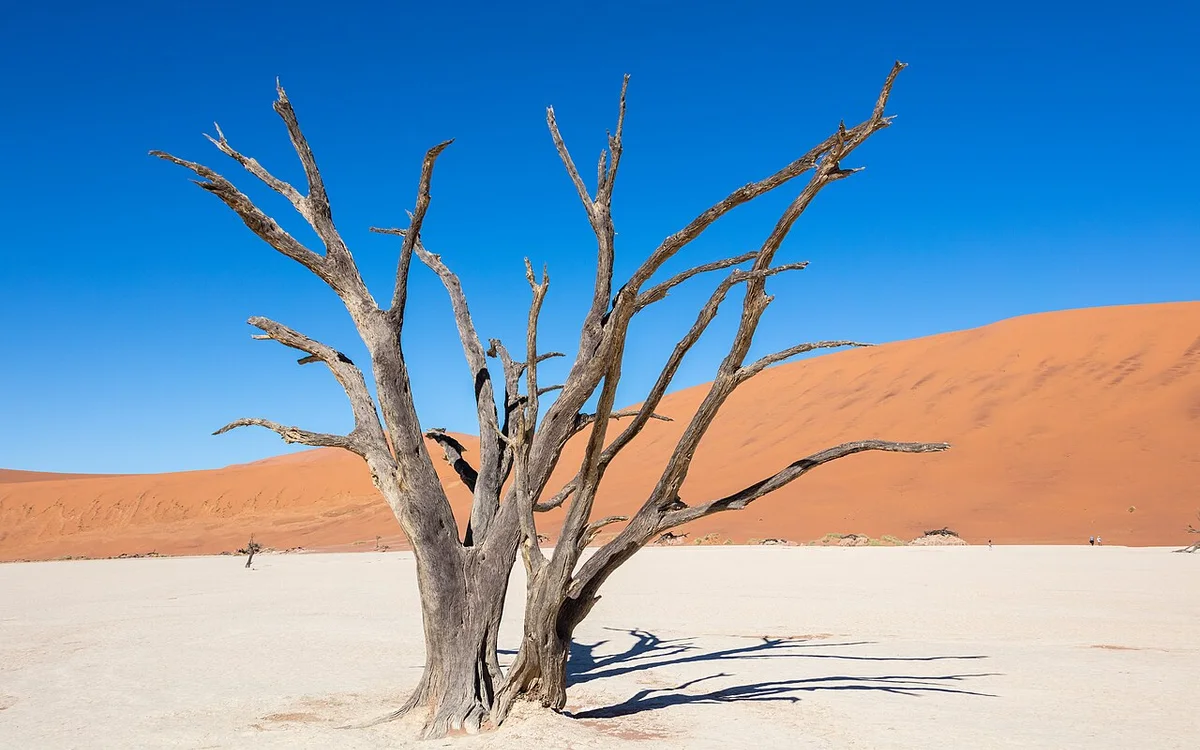
Towering rust-orange star dunes flanking the ghostly dead camel thorn trees of Deadvlei.
Geographic Essence & What Makes It Unique
Part of the ancient Namib Desert—the oldest desert on Earth with sand fields accumulating over 55 million years—Sossusvlei is a surreal landscape of monumental scale. The rust-orange dunes, enriched by iron oxide, rise more than 300 meters into spotless blue desert skies. At Deadvlei, a blinding white clay pan holds 900-year-old scorched camel thorn trees that cannot decompose in the parched atmosphere, creating one of photography's most poignant minimalist compositions.
Concrete Landmarks & Terrains to Explore
Deadvlei
A dried white clay pan surrounded by the highest dunes in the world, studded with black fossilized camel thorn acacia trees.
Big Daddy Dune
The reigning star dune of the Sossusvlei area, towering 325 meters above the valley floor.
Dune 45
Gracefully contoured 80-meter dune located 45 km from Sesriem gate, famous for its accessible ridgeline climb at sunrise.
Sesriem Canyon
A natural sedimentary gorge 30 meters deep carved over two million years by seasonal flash floods.
Core Exploration Experiences
- Climb the razor-sharp ridge of Big Daddy dune at dawn for panoramic views over endless sand seas.
- Walk onto the cracked white clay floor of Deadvlei as the first morning sun lights the red dunes behind dark skeleton trees.
- Explore the narrow, shadowed depths of Sesriem Canyon carved by the ephemeral Tsauchab River.
- Stargaze in the NamibRand Nature Reserve, an officially designated International Dark Sky Reserve with zero light pollution.
Seasonality & Optimal Travel Months
May through October offer the coolest desert temperatures, crisp blue skies, and manageable midday heat. November through March can experience blistering heat exceeding 40°C.
Balanced Editorial Assessment
Key Advantages
- Some of the most dramatic and photogenic desert scenery found anywhere on Earth.
- Exceptional night sky clarity with world-class celestial viewing and astrophotography.
- Safe, well-maintained gravel roads suitable for independent self-drive travel.
Drawbacks & Real Challenges
- The final 5 km into the vlei requires high-clearance 4x4 driving through deep, soft sand (or a paid tractor shuttle).
- Extreme temperature swings between freezing dawn mornings and hot midday sun.
- Very long driving distances over corrugated gravel roads across Namibia.
Field Notes & Planning Intelligence
- Stay at a lodge inside the park's first gate (such as Sesriem Campsite or Sossus Dune Lodge) to access the dunes an hour before public sunrise gates open.
- Lower tire pressure to 1.4-1.6 bar before driving the soft sand stretch to Sossusvlei.
- Carry at least 5 liters of drinking water per person and begin dune climbs at first light.
Comparable Geographic Alternatives
Verified Research Sources
This profile was verified using records from primary government, conservation, and meteorological bodies.
- Ministry of Environment, Forestry and Tourism of Namibia (MEFT) — Namib-Naukluft Park gate entry permits, speed limits, and 4x4 sand corridor rules.
- UNESCO World Heritage Centre — Outstanding universal value as the only coastal desert containing extensive fog-dune fields.
- Namibia Meteorological Service — Extreme diurnality records showing 35°C daytime drops to near freezing overnight.