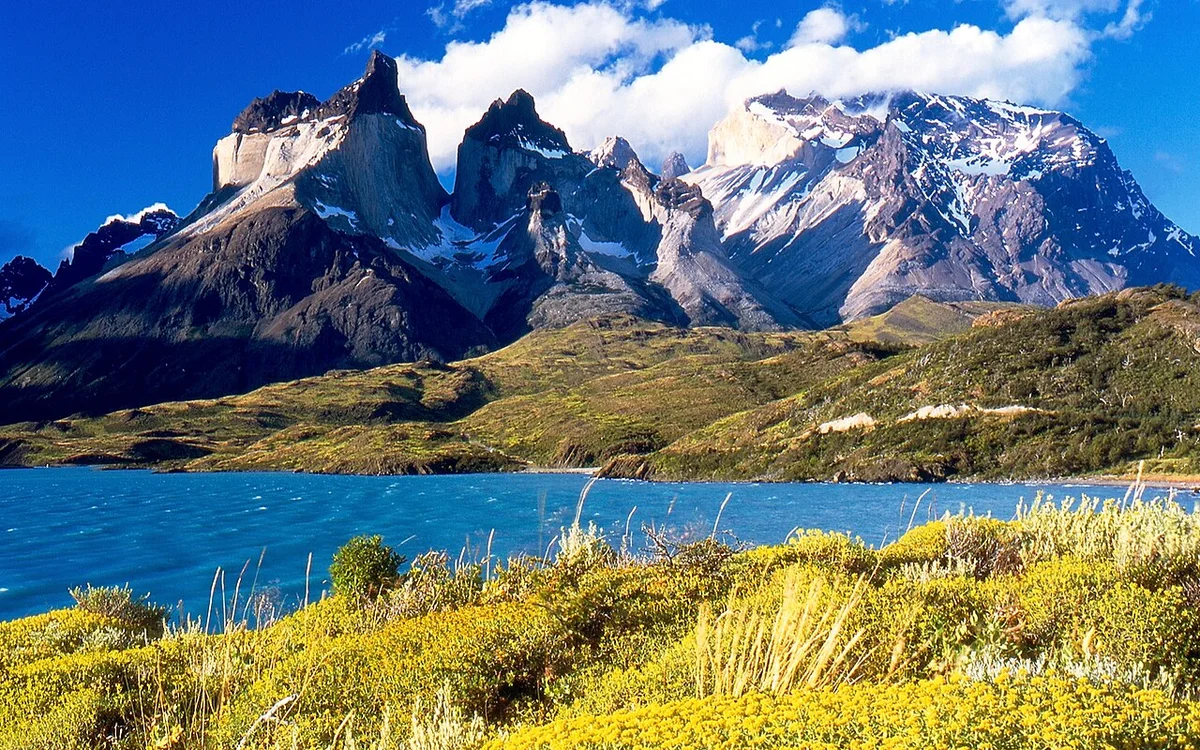
Torres del Paine
The dramatic crown of Patagonia: granite horns, turquoise glacial lakes, and sweeping ice fields.
Geographic Essence & What Makes It Unique
Rising sheer from the windswept Patagonian steppe, the Cordillera del Paine presents one of Earth's most violently dramatic mountain profiles. Sculpted by the immense Southern Patagonian Ice Field, this granite-and-sedimentary massif features contrasting bicolored rock horns (Cuernos del Paine), three monumental granite monoliths (the Towers), and colossal calving glaciers that drop blue icebergs into milky-turquoise lakes.
Concrete Landmarks & Terrains to Explore
Mirador Las Torres
Natural glacial amphitheater holding a turquoise lagoon directly beneath the three vertical granite monoliths.
Los Cuernos del Paine
Spectacular multi-hued mountain horns showing black sedimentary caps atop pale granite intrusions.
Glaciar Grey
Massive six-kilometer-wide tongue of the Southern Patagonian Ice Field terminating into Lake Grey.
Valle del Francés
Hanging mountain valley surrounded by sheer granite walls and cascading seracs from Glacier Francés.
Core Exploration Experiences
- Hike up the Ascencio Valley at dawn to witness the Three Towers glow fiery red in morning light.
- Trek the legendary W-Circuit or complete the 8-day O-Circuit around the entire massif.
- Sail on a catamaran across Lake Pehoé toward Paine Grande under ferocious Patagonian gusts.
- View the jagged blue ice wall of Grey Glacier calving directly into iceberg-strewn Lake Grey.
Seasonality & Optimal Travel Months
November through March offers southern summer with the longest daylight (up to 17 hours) and warmest temperatures, though fierce Patagonian winds peak during these months.
Balanced Editorial Assessment
Key Advantages
- One of the premier, most iconic trekking destinations on the globe.
- Pristine wilderness with exceptional conservation enforcement and minimal litter.
- Abundant wildlife sightings including guanacos, Andean condors, and elusive Patagonian pumas.
Drawbacks & Real Challenges
- Mandatory advance booking for all trail campsites and refugios; independent wild camping is strictly illegal.
- Ferocious winds frequently exceeding 100 km/h can knock trekkers off their feet.
- Extremely changeable weather where all four seasons can manifest in a single afternoon.
Field Notes & Planning Intelligence
- Book trail camping/refugio reservations 6 months in advance through CONAF, Las Torres, and Vertice Patagonia.
- Invest in professional four-season windproof and waterproof trekking gear.
- Fly into Puerto Natales or Punta Arenas and organize regional bus tickets ahead of time.
Comparable Geographic Alternatives
Verified Research Sources
This profile was verified using records from primary government, conservation, and meteorological bodies.
- Corporación Nacional Forestal de Chile (CONAF) — Strict reservation requirements for W-Trek and O-Circuit campsites, fire safety laws, and trail passes.
- Servicio Nacional de Turismo de Chile (SERNATUR) — Regional Magallanes transport logistics and catamaran schedules across Lake Pehoé.
- Dirección Meteorológica de Chile (DMC) — Patagonian wind velocity records and unpredictable Southern Ocean frontal storm metrics.